Laser welding is a remarkable advancement in industrial fabrication, offering unique benefits compared to traditional welding methods. Understanding "how strong is laser welding compared to traditional welding" is vital for manufacturers seeking efficient solutions. According to a report by the American Welding Society, laser welding provides superior precision and strength, often resulting in a joint strength that exceeds typical welds by 20-50%. This enhanced strength is attributed to the focused energy delivery and reduced heat-affected zones, which prevent warping and weaknesses in the base material.
For many applications, laser welding achieves near-complete penetration in thinner materials, while traditional methods may leave weak spots. However, it’s essential to recognize that laser welding isn’t a one-size-fits-all solution. Factors such as material type and thickness impact outcomes, and the initial investment can be high. Many companies find it challenging to transition their workforce to adopt this technology effectively. The industry needs to weigh these factors carefully to determine the best welding method for their specific demands. Despite its advantages, integrating laser welding can pose logistical hurdles that require thoughtful consideration and adaptation.
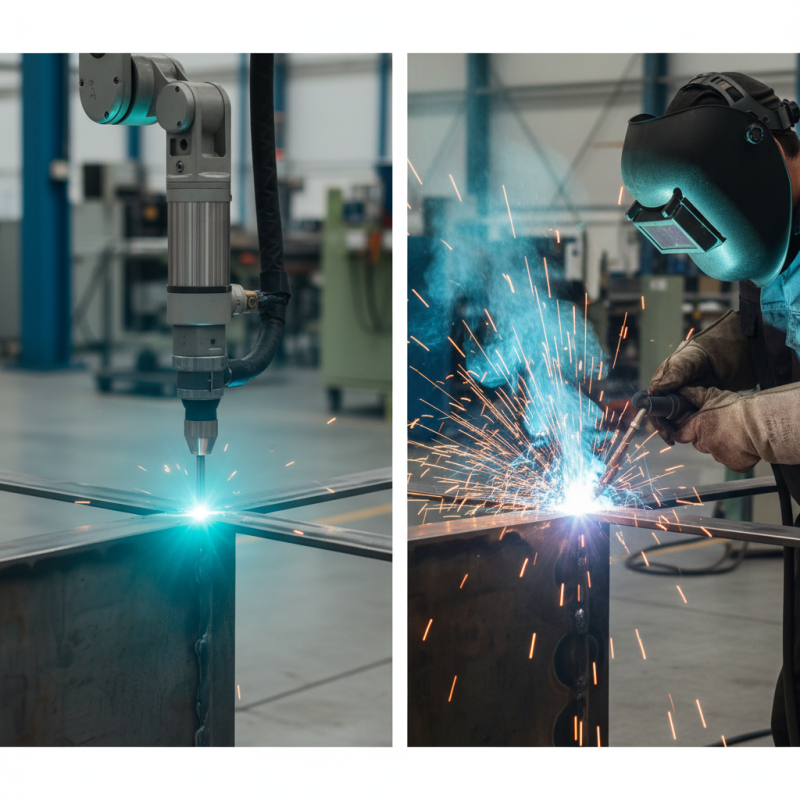
Comparison of Laser Welding and Traditional Welding Techniques
Laser welding and traditional welding techniques offer distinct advantages and drawbacks in various applications. Laser welding utilizes a focused beam of light to melt materials, achieving precision and speed that traditional methods often cannot match. According to industry reports, laser welding can complete a task in one-third of the time required by conventional welding. This efficiency can significantly reduce production costs.
However, laser welding is not universally superior. The initial investment in laser welding technology can be steep. Traditional welding offers more flexibility in terms of the types of materials and thicknesses it can handle. A study from the American Welding Society indicates that laser welding may struggle with certain high-mass applications. This limitation raises questions about its overall versatility compared to simpler methods like MIG or TIG welding.
Furthermore, laser welding requires specific training for workers to operate advanced equipment effectively. The skill gap may lead to inconsistent results, particularly in less experienced hands. On the other hand, traditional methods may face challenges in quality control, especially when dealing with varied joint designs. Each technique has unique strengths and weaknesses, indicating that a one-size-fits-all approach may not be viable in welding processes.
How Strong is Laser Welding Compared to Traditional Welding? - Comparison of Laser Welding and Traditional Welding Techniques
| Criteria |
Laser Welding |
Traditional Welding |
| Strength of Weld |
High |
Moderate to High |
| Heat Affected Zone (HAZ) |
Small |
Large |
| Welding Speed |
Fast |
Slower |
| Material Thickness |
Thin to Medium |
Thin to Thick |
| Post-Weld Treatment |
Minimal |
Often Required |
| Cost |
Higher Initial Setup |
Lower Initial Setup |
| Operator Skill Level |
High |
Moderate |
Key Factors Influencing the Strength of Laser Welds
Laser welding offers unique advantages over traditional methods. However, several factors influence the strength of laser welds. The focus of the laser beam, the material type, and the thickness of the components all play a crucial role. For instance, a tight focus allows for a more concentrated energy distribution. This can lead to deeper penetration in thick materials, resulting in stronger welds.
Proper parameters must be set for optimal performance. The travel speed and power of the laser can significantly impact the weld quality. A slower travel speed may result in more heat input, but overheating can lead to distortion. Balancing these variables is essential.
Tips: Always conduct test welds to fine-tune settings. Make sure to clean the surfaces thoroughly to avoid contaminants. Understanding the material properties will guide you in selecting appropriate laser settings. Adjustments based on the test results can improve overall weld strength.
Comparative Strength of Laser Welding vs Traditional Welding
This bar chart illustrates the ultimate tensile strength of different welding methods, showcasing how laser welding surpasses traditional techniques in terms of strength. With a tensile strength of 600 MPa, laser welding demonstrates significant advantages over MIG, TIG, and Stick welding methods.
Mechanical Properties of Laser Welded Joints
Laser welding has gained popularity for its precision and efficiency, yet understanding its mechanical properties compared to traditional welding is crucial. Studies show that laser-welded joints often exhibit superior tensile strength. For example, a report from the American Welding Society highlights that laser welding can achieve a tensile strength nearly 15% higher than that of MIG welded joints. This is primarily due to the concentrated heat and rapid cooling rates, which promote finer microstructures.
However, not all is perfect. Some researchers have noted that the brittleness of certain laser-welded joints can lead to unexpected failures under stress. For instance, a European metallurgical study found that some laser-welded components suffered from a higher incidence of fatigue failures compared to conventionally welded parts. This raises concerns about the long-term reliability of laser welds in critical applications.
The heat-affected zone (HAZ) can also pose challenges. While laser welding minimizes HAZ size, when it does occur, it can be more sensitive to cracking. A report from the International Institute of Welding points out that managing this risk requires expertise in selecting the right parameters. The ongoing research into optimizing laser welding processes reflects the industry's commitment to enhancing joint performance while addressing these concerns.
Quality and Consistency in Laser vs. Traditional Welding
Laser welding offers significant advantages in quality and consistency compared to traditional welding methods.
According to a report by the American Welding Society, laser welding can achieve a repeatability rate of over 95%.
This contrasts sharply with traditional methods, where variability can lead to defect rates around 10%.
The precision of lasers allows for smaller heat-affected zones, which minimizes warping and distortion in materials.
Moreover, laser welding's ability to create fine, consistent joints translates into stronger end products.
A study from the International Journal of Advanced Manufacturing Technology notes that laser welds often exhibit over 10% higher tensile strength than traditional welds.
However, achieving these superior results requires skilled operators. Not every laser welding setup guarantees high quality.
The environment and settings must be meticulously controlled to maintain these standards.
While laser welding clearly demonstrates advantages, it isn't without concerns. The initial investment in laser technology can be daunting for some manufacturers.
Training personnel to operate this equipment effectively also adds to the challenge.
Untrained operators can compromise the welding quality, leading to unintended flaws. Balancing technology with human expertise remains crucial in this evolving field.
Applications and Limitations of Laser Welding in Industry
Laser welding has become increasingly popular in various industrial applications due to its precision and speed. It excels in tasks requiring intricate designs and tight tolerances, such as in the electronics and automotive sectors. The focused energy of lasers allows for deep penetration welding, enabling the fusion of dissimilar materials.
However, this technology isn't without its challenges.
One limitation of laser welding is the initial setup cost, which can be high. Not all manufacturers can afford this equipment, especially small businesses. Additionally, the process requires a skilled operator who understands both technology and material properties. If the technique is misapplied, it can lead to poor joint integrity.
Another downside is the sensitivity to surface conditions. Contaminants such as rust or oil can significantly affect the effectiveness of laser welding. In situations where surface preparation is inadequate, the results may not meet desired standards.
Balancing the advantages and drawbacks is crucial for industries adopting laser welding as a primary method. Each operation needs careful consideration of its unique requirements and limitations.
FAQS
: The focus of the laser beam, material type, and component thickness are key factors.
A tight focus allows for deeper penetration in thick materials, leading to stronger welds.
Test welds help fine-tune settings for optimal performance and improve overall weld strength.
Overheating can cause distortion, negatively impacting weld quality.
Laser welding can achieve higher tensile strength but may have higher brittleness in some joints.
Some joints may suffer from fatigue failures, raising concerns about long-term reliability.
HAZ is an area affected by heat during welding, which can be sensitive to cracking.
Yes, high initial setup costs and the need for skilled operators are significant hurdles.
Contaminants like rust or oil can significantly reduce the quality of laser welds.
They need to balance advantages and drawbacks based on unique requirements and limitations.
Conclusion
Laser welding has emerged as a powerful technique in metal joining, prompting questions about how strong is laser welding compared to traditional welding methods. This comparison reveals that laser welding often exhibits superior strength due to its precise heat application and focused energy, resulting in minimized distortion and greater control over the weld pool. Key factors influencing the strength of laser welds include parameters like laser intensity, material thickness, and joint design, all of which can contribute to enhanced mechanical properties of the welded joints.
Moreover, laser welding is recognized for its exceptional quality and consistency, outperforming traditional methods in many instances. However, it also has limitations, such as initial equipment costs and the need for specialized training. Despite these challenges, the applications of laser welding are expanding across various industries, showcasing its efficacy and potential for high-quality results, ultimately reaffirming its value and strength compared to traditional welding techniques.

 STYRL Laser